

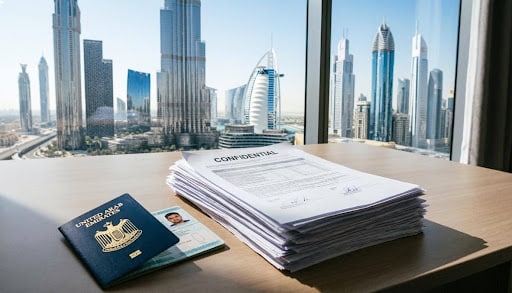
Most founders planning freezone company formation in Dubai assume the hard part is choosing a business activity or picking a free zone. It rarely is. The part that actually slows people down, sometimes by weeks, is paperwork: missing attestations, mismatched company names across documents, or a shareholder structure that doesn’t match what the application form expects.
Free zone authorities in Dubai process thousands of new company applications every year, and the majority of rejections or delays trace back to documentation, not eligibility. Get the paperwork right the first time, and a license can be issued in as little as three to five working days. Get it wrong, and that timeline can stretch past a month while documents get resubmitted, re-attested, or translated.
This guide breaks down exactly what you need, in what order, and why each document matters.
Why Document Preparation Decides Your Setup Timeline
Dubai’s free zones operate on a document-first model. Unlike some jurisdictions where a company can be registered and documents filed later, UAE free zones require most core paperwork upfront, before a trade license is issued.
A typical free zone application moves through three checkpoints: initial approval, document verification, and license issuance. Each checkpoint has its own document requirements, and a single missing item at the verification stage can push the entire application back to the queue.
Founders who prepare a complete document set before submitting tend to receive initial approval within 1 to 2 working days. Those who submit incomplete files often wait 10 to 15 working days longer, simply because of back-and-forth communication with the free zone’s registration team.
The takeaway: treat document preparation as the first phase of your business setup, not an afterthought to be handled once approval is granted.
The Document Readiness Pipeline
To make this manageable, it helps to think of free zone documentation in four stages. Each stage builds on the one before it, and skipping ahead usually creates problems later.
Stage 1: Personal Identity Documents
These establish who you are as a shareholder or director. Every free zone in Dubai requires:
- Valid passport copies for all shareholders and directors, with at least six months of validity remaining
- Passport-size photographs on a white background, meeting UAE visa photo specifications
- Proof of current residential address, such as a recent utility bill or bank statement, usually dated within the last three months
- No Objection Certificate (NOC) if you currently hold a UAE residence visa sponsored by another employer or entity
If you’re a UK or EU national applying from abroad, your passport and address proof rarely need attestation at this stage. That changes for entity-level documents, covered next.
Stage 2: Business Structure Documents
This is where the legal shape of your company gets defined. Requirements vary slightly depending on whether you’re setting up as an individual shareholder or through a corporate entity.
For individual shareholders:
- Completed application form, specifying the proposed company name (three options are usually requested in case of name conflicts)
- Memorandum and Articles of Association (MOA/AOA), often provided as a template by the free zone but requiring shareholder details to be filled in correctly
- Specimen signature forms for each shareholder and director
For corporate shareholders, where another company owns shares in the new UAE entity, add:
- Certificate of Incorporation of the parent company, attested and translated if not issued in English or Arabic
- Board resolution authorizing the UAE company setup, signed by the parent company’s directors
- Power of Attorney (POA) appointing a representative to sign on the parent company’s behalf in the UAE
This is the stage where attestation requirements most commonly catch people out. A Certificate of Incorporation issued in the UK, for example, typically needs notarization, then legalization through the UK Foreign, Commonwealth and Development Office, followed by attestation at the UAE Embassy in London before it’s accepted by a Dubai free zone.
Translation adds another layer. Any document not issued in English or Arabic needs a certified translation, usually completed by a UAE Ministry of Justice approved legal translator once the document arrives in the country. Founders sometimes get documents translated in their home country first, only to find the free zone requires a local UAE translation instead. Check with your chosen free zone before paying for translation work abroad.
Stage 3: Activity-Specific Licensing Documents
Once your identity and structure documents are in order, the next layer depends entirely on what your business actually does. Free zones categorize licenses broadly into trading, service, professional, and industrial activities, and each carries its own additional requirements.
Common activity-specific documents include:
- Educational certificates or professional qualifications required for licensed professional activities such as consulting, legal services, or healthcare-related businesses
- Prior experience letters sometimes requested for activities that require demonstrated industry background
- External approvals where certain activities (food and beverage, healthcare, education, financial services) need sign-off from a relevant UAE authority before the free zone will issue a license
- Trademark or brand documentation if the proposed trade name includes a registered brand or trademark
Trading and general consulting licenses, which represent the majority of free zone applications, usually require nothing beyond the Stage 1 and Stage 2 documents. Regulated activities are the exception, not the rule, but they’re worth checking before you commit to a business activity, since external approvals can add two to four weeks to the timeline.
Stage 4: Post-Incorporation Compliance Documents
These don’t block your initial license, but they become mandatory shortly after incorporation, and founders who plan for them early avoid scrambling later.
- Lease agreement (Ejari or free zone equivalent), required for visa applications and renewals
- Corporate bank account documentation, including the trade license, MOA, and shareholder passports, which banks will request during account opening
- Tax registration documents, which now apply to nearly every UAE company regardless of free zone status
This last point deserves its own section, because it’s the one area where the rules have shifted significantly in recent years.
How Document Processing Times Vary for Freezone Company Formation in Dubai
Not every Dubai free zone reviews documents at the same speed, and the differences are worth knowing before you choose where to register.
Free zones built around digital-first registration, where applications and documents are submitted entirely online, tend to process initial approval in 1 to 2 working days and full license issuance in 3 to 5 working days once payment clears. Free zones with a more traditional in-person submission model can take longer, sometimes 7 to 10 working days for the same steps, simply because documents are reviewed manually and queued by appointment.
The activity you’re licensing also affects which authority reviews your file. A consulting or general trading license usually stays within the free zone’s own registration team from start to finish. A regulated activity, such as anything touching financial services, healthcare, or education, gets routed to the relevant federal authority for an additional approval layer, and that step sits outside the free zone’s control entirely. Founders planning a regulated activity should budget an extra two to four weeks for this approval before the free zone can issue the license, regardless of how complete their own document set is.
One practical takeaway: if your document set is genuinely complete and your activity is unregulated, the choice of free zone can affect your timeline by a week or more. That’s worth factoring in alongside cost when comparing options.
Free Zone vs Mainland: Where the Document Lists Diverge
UK entrepreneurs comparing jurisdictions sometimes look at the EU as the default expansion route. Brexit reshaped the practical realities of doing business across Europe for many UK founders, which is part of why some are now looking at the Gulf as an alternative base rather than a workaround. If you’re weighing up setting up a company in the Netherlands against a Gulf jurisdiction, the document requirements are a useful comparison point. Both routes involve attestation chains and structure documents, but Dubai free zones tend to move faster once the paperwork is correct, often issuing licenses within days rather than weeks.
Within the UAE itself, mainland and free zone setups diverge in a few specific ways:
- Mainland companies generally require a local service agent agreement or, for certain activities, a local Emirati shareholder holding a stake in the business
- Free zone companies allow 100 percent foreign ownership without a local partner requirement, which simplifies the shareholder documentation considerably
- Initial approval documents for mainland setups often go through the Department of Economic Development, while free zone applications are processed entirely within the free zone authority
For most foreign founders, particularly those not planning to trade directly within the UAE local market, free zone setup involves a shorter document list and fewer approval layers.
Five Document Mistakes That Push Back Your Trade License
These are the errors that show up most often in rejected or delayed applications.
- Name mismatches across documents. If your passport shows “Mohammed Ali Khan” but your bank statement shows “M.A. Khan,” the free zone may request clarification or additional proof of identity. Consistency across every document matters more than founders expect.
- Outdated address proof. Many free zones require utility bills or bank statements dated within 90 days. A six-month-old document gets rejected on submission, costing you a full review cycle.
- Missing attestation on corporate documents. A Certificate of Incorporation without UAE Embassy attestation is one of the most common reasons corporate shareholder applications stall.
- Incomplete shareholder structure for corporate entities. If a parent company has multiple layers of ownership, free zones increasingly request the full ownership chain, not just the immediate parent.
- Choosing a trade name before checking availability. Submitting an application with a trade name that’s already registered, or that includes restricted words, sends the entire application back for a name change before anything else can proceed.
Bold takeaway: none of these mistakes are about eligibility. They’re about preparation, and every one of them is avoidable with a checklist done in advance.
How Corporate Tax UAE Registration Changes Your Document Checklist
Since the UAE introduced federal corporate tax, every free zone company, regardless of size or activity, now needs to register for a Corporate Tax Registration Number with the Federal Tax Authority, generally within three months of incorporation.
This adds a document to Stage 4 that didn’t exist a few years ago: proof of Tax Registration Number (TRN) application or certificate, which is now requested by banks during account opening and by some free zones during license renewal.
Free zone companies meeting Qualifying Free Zone Person criteria can still benefit from a 0 percent rate on qualifying income, but the registration requirement applies regardless of whether the eventual tax rate is 0 percent or 9 percent. Founders who treat this as optional, assuming free zone status exempts them entirely, often find themselves needing to register retroactively, which can involve penalty exposure for late registration.
For a full breakdown of what qualifies as qualifying income, the exemption thresholds, and how the regime applies specifically to free zone entities, the corporate tax UAE guide covers the current framework in detail and is worth reviewing before you finalize your business activity, since some activities are treated differently under the qualifying income rules.
From Document Collection to Trade License: The Step-by-Step Process
With your documents organized by stage, the actual submission process follows a fairly predictable sequence:
- Initial name and activity approval. Submit your proposed trade names and business activity for approval. This typically takes 1 to 2 working days and confirms there’s no conflict before you invest further in documentation.
- Document submission for verification. Submit Stage 1 and Stage 2 documents together. The free zone’s registration team reviews these for completeness and attestation validity.
- Payment of license fees. Once documents are verified, license and registration fees are due. Fee structures vary by free zone and by the number of visas requested alongside the license.
- License issuance. With fees paid and documents approved, the trade license is issued, usually within 1 to 3 working days of payment confirmation.
- Post-incorporation steps. Lease agreement signing, bank account opening, and corporate tax registration follow within the first few weeks.
If this is your first time going through freezone company formation in Dubai, working through this process with a setup provider that handles the attestation chain and document verification on your behalf can cut weeks off the timeline, particularly for corporate shareholder structures where attestation requirements are most demanding.
Timing matters beyond just the paperwork. Dubai’s business environment has been expanding quickly across multiple sectors, and the growth in Dubai’s property and technology investment is part of why the current wave of activity in the city is increasingly about complete, integrated systems rather than standalone projects. A free zone company gives founders a registered entity to participate in that growth from day one, rather than waiting on a slower mainland approval chain.
Final Pre-Submission Checklist
Before you submit anything, run through this list:
- ☐ Passport copies for all shareholders and directors, valid for 6+ months
- ☐ Passport-size photographs meeting UAE specifications
- ☐ Address proof dated within the last 90 days
- ☐ NOC from current UAE sponsor, if applicable
- ☐ Completed application form with three trade name options
- ☐ MOA/AOA with correct shareholder details
- ☐ Specimen signatures for all shareholders and directors
- ☐ Attested Certificate of Incorporation, if a corporate shareholder is involved
- ☐ Board resolution and Power of Attorney, if applicable
- ☐ Activity-specific approvals confirmed and obtained, if your activity requires them
- ☐ Trade name availability checked before final submission
The Bottom Line
The documents required for Dubai free zone company setup aren’t complicated individually. What trips founders up is sequencing: submitting the wrong combination, missing an attestation step, or not realizing a particular business activity needs external approval until the application is already in progress.
Build your document set in the order outlined here, personal identity first, then structure, then activity-specific items, and the process moves about as fast as Dubai’s free zones are designed to allow. For UK founders weighing up where to base an international expansion, a clean document pipeline is often the difference between a license in a week and a license in a month.