

Ask an engineering leader how big their team is and you used to get a number. Twenty-eight. Forty. A hundred and twelve. The number meant something, because everyone it counted was hired the same way, paid the same way, and expected to be there next year.
That answer has quietly stopped working. Ask the same question now and the honest reply is a breakdown: this many permanent engineers, this many contractors on a six-month scope, this much capacity through a partner, this much work absorbed by tooling that did not exist two years ago.
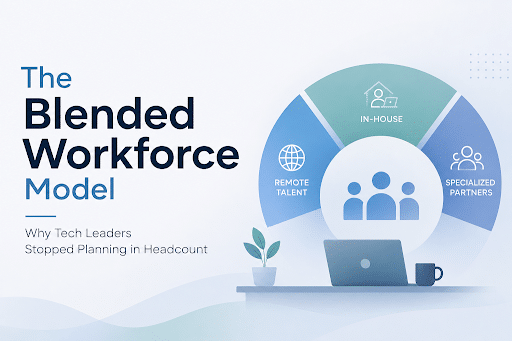
A blended workforce model is an operating approach where a company plans engineering capacity as a deliberate mix of permanent employees, contract specialists, and partner-delivered teams, rather than treating full-time headcount as the only way to add capability.
The shift is no longer marginal. Robert Half’s workforce research found sixty-five percent of technology leaders increased their reliance on contract talent last year. Gartner estimates more than sixty percent of companies will depend on flexible models to stay competitive. Roughly eighty-three percent of organizations say they are willing to use contingent workers to meet business needs, and more than seventy-five percent of executives plan to outsource some IT function outright.
What changed is not the willingness to hire. It is the belief that hiring is the answer to every capacity question.
Key takeaways before the detail:
- Contract and partner capacity is now a planning default in technology, not a gap-filler used under pressure.
- The constraint has moved from cost to speed: companies buy capability they cannot hire fast enough.
- Most organizations adopting the model are not operationally ready to run it, and that gap is where value leaks.
- The right permanent-to-flexible ratio depends on how durable the work is, not how important it is.
Why Are Tech Leaders Shifting to Contract Talent?
The reflexive explanation is cost, and it is mostly wrong. Cost was the driver fifteen years ago. Today the binding constraint is time.
Companies are buying flexible capacity because the skills they need change faster than a hiring cycle can deliver them. A platform migration needs a specialist for five months, not forever. An AI feature needs someone who has shipped retrieval systems before, and that person is not going to appear in a ninety-day pipeline. Meanwhile the offshore development market has grown to roughly one hundred ninety-eight billion dollars, and the motivation cited most often by buyers has shifted from savings to access.
There is a second reason nobody puts in a press release. Permanent headcount is the hardest commitment a company makes and the slowest to undo. After several years of correction across the sector, leaders are reluctant to convert an eighteen-month roadmap into a permanent cost base that outlives it.
None of this makes the model easy. Blended teams introduce coordination, onboarding, knowledge retention, and accountability problems that single-employer teams never had, and the organizations that struggle are usually the ones that adopted the model without planning for those, which is why understanding the staff augmentation challenges and how to handle them matters more than picking the right vendor. The model is not the hard part. Running it is.
What Does the Readiness Gap Actually Look Like?
There is a striking piece of evidence that this shift has outrun the management capability behind it.
Deloitte, whose Global Human Capital Trends research surveys tens of thousands of leaders across industries and has anchored workforce strategy thinking for over a decade, found in its workforce ecosystem study that eighty-four percent of executives consider managing a blended workforce important to organizational success, while only sixteen percent say they are ready to do it.
That sixty-eight-point gap between intent and readiness is the real story. It explains why two companies can run the same model with the same partner and get completely different results.
The gap is not about talent quality. It is about plumbing: who owns a contractor’s onboarding, where their work is documented, whether they appear in the same planning ritual as everyone else, and what happens to their knowledge when the engagement closes.
Why Headcount Stopped Being a Useful Planning Unit
Headcount was a good proxy when every unit was identical. One engineer meant one full-time person, one salary line, and one indefinite commitment. Planning meant counting.
That proxy breaks the moment capacity arrives in different shapes. A senior contractor for four months, a partner pod of three, and a permanent hire starting in two quarters are all capacity, but they carry different costs, different ramp times, different reversibility, and different knowledge retention.
Deloitte’s research makes the same point from the planning side: workforce planning based entirely on jobs and headcount no longer offers the agility organizations need, and planners are increasingly modelling tasks and skills instead of seats.
The practical replacement is capacity planning: forecast the work, classify how durable it is, then choose the employment shape that matches. Companies that make this switch stop having the argument about whether contractors are cheaper and start having a more useful one about what work belongs where.
What Work Belongs Permanent and What Belongs Flexible?
This is the decision that determines whether the model produces leverage or chaos, and the sorting rule is simpler than most frameworks make it.
Durability decides placement, not importance. Work that compounds institutional knowledge belongs permanent. Work that is bounded, specialized, or seasonal belongs flexible.
Keep permanent:
- Core architecture and the decisions future work will be built on.
- Domain logic that is genuinely specific to your business.
- Anything requiring long-run context that would be expensive to rebuild.
- Technical leadership, mentorship, and code review standards.
Make flexible:
- Time-boxed projects with a clear finish line, such as migrations and integrations.
- Specialized skills needed intensely for months rather than permanently.
- Surge capacity around a launch, an audit, or a compliance deadline.
- Well-defined maintenance and operational work that needs reliability, not invention.
The common failure is inverting this. Companies keep routine maintenance in-house because it feels safe, then bring external specialists in to make architectural decisions nobody will be around to explain in a year.
How Do You Decide the Right Ratio?
There is no universal number, and any consultant offering one is selling something. But the inputs are consistent.
Start with roadmap volatility. If more than a third of next year’s plan is genuinely uncertain, a heavier flexible share protects you from committing to a cost base built on assumptions. Then look at skill half-life: capabilities that will still matter in five years justify permanent investment, while a framework-specific need probably does not.
Weigh knowledge risk honestly. If losing a person would cost months of rediscovery, that work belongs permanent regardless of budget. And check management bandwidth, because flexible capacity is not management-free capacity. A team already at its coordination limit will not get more output by adding externally sourced engineers to it.
As a working starting point, most product engineering organizations land between seventy and eighty-five percent permanent, with the remainder flexible, and shift that band with the roadmap. Consultancies and agencies run far lower. Regulated platforms run higher.
What Breaks When a Blended Model Is Run Badly?
The failure modes are predictable enough that they can be listed, and every one of them is an operations problem rather than a sourcing problem:
- Two-tier culture, where external engineers are excluded from planning and standups and then blamed for lacking context.
- Knowledge evaporation, where an engagement ends and the reasoning behind the work leaves with it.
- Onboarding drag, where every new person costs three weeks of a senior engineer’s time because nothing is documented.
- Accountability confusion, where nobody can say who owns a service after the people who built it rotated out.
- Review bottlenecks, where added capacity produces more code than the permanent team can actually review.
Notice what is absent from that list. None of it is caused by the engineers being external. All of it is caused by an operating model that assumed they would absorb context by proximity, which was never true even for employees.
How Do You Measure a Blended Team?
Traditional engineering metrics assume a fixed roster, so they mislead badly here. Velocity per sprint drops the moment new people join, whether they are permanent or not.
Better questions to instrument: how long does it take a new contributor to ship something meaningful, and is that number falling? What share of delivered work came from flexible capacity, and did quality differ? How much senior time goes to onboarding and review, and is that scaling faster than output? When an engagement ends, how much rework follows in the next quarter?
That last one is the honest verdict on the whole model. If ending an engagement causes a spike in defects and rediscovery, the capacity was rented but the knowledge was never actually transferred.
Frequently Asked Questions (FAQ’s)
Q1. What is a blended workforce model in technology?
It is an operating model where engineering capacity is planned as a deliberate mix of permanent employees, contract specialists, and partner-delivered teams. Each type of work is matched to the employment shape that fits its duration, specialization, and knowledge requirements rather than defaulting to full-time hiring.
Q2. Why are tech leaders increasing contract talent in 2026?
Speed and specialization, more than cost. Robert Half research found sixty-five percent of technology leaders increased reliance on contract talent last year, largely because required skills change faster than hiring cycles can deliver them and permanent headcount is the slowest commitment to reverse.
Q3. What is a healthy ratio of permanent to flexible engineers?
Most product engineering organizations operate between seventy and eighty-five percent permanent. The right level depends on roadmap volatility, how long the needed skills stay relevant, how much knowledge risk the work carries, and how much management bandwidth exists to coordinate it.
Q4. Does a blended workforce model reduce engineering costs?
Sometimes, but that is not why most companies adopt it. The bigger gains are avoided cost: no severance exposure when a project ends, no long recruitment cycle for a short-term need, and no permanent salary line attached to work that lasted two quarters.
Q5. What is the biggest risk of a blended workforce model?
Knowledge loss at the end of an engagement. If documentation, architectural reasoning, and ownership are not transferred deliberately, the organization pays twice: once for the original work and again to rediscover how it functions.
Q6. How is this different from traditional outsourcing?
Outsourcing typically transfers a whole function and its management to a vendor. A blended model keeps direction, prioritization, and technical standards in-house while sourcing capacity in different shapes, so external engineers work inside the company’s own process rather than parallel to it.
Final Verdict
The move away from headcount planning is not a temporary reaction to a difficult market. It is what happens when the rate of technical change outruns the rate at which organizations can hire, and there is no evidence of that reversing.
But the statistic worth remembering is not the sixty-five percent adopting flexible talent. It is the sixteen percent who say they are ready to manage it. That is where the outcomes actually separate, and it has nothing to do with which partner anyone chose.
The companies that get this right will not be the ones with the cleverest sourcing strategy. They will be the ones that treated capacity as something to design deliberately, wrote down what they know, and made it genuinely irrelevant which employment category a good engineer arrived through.