
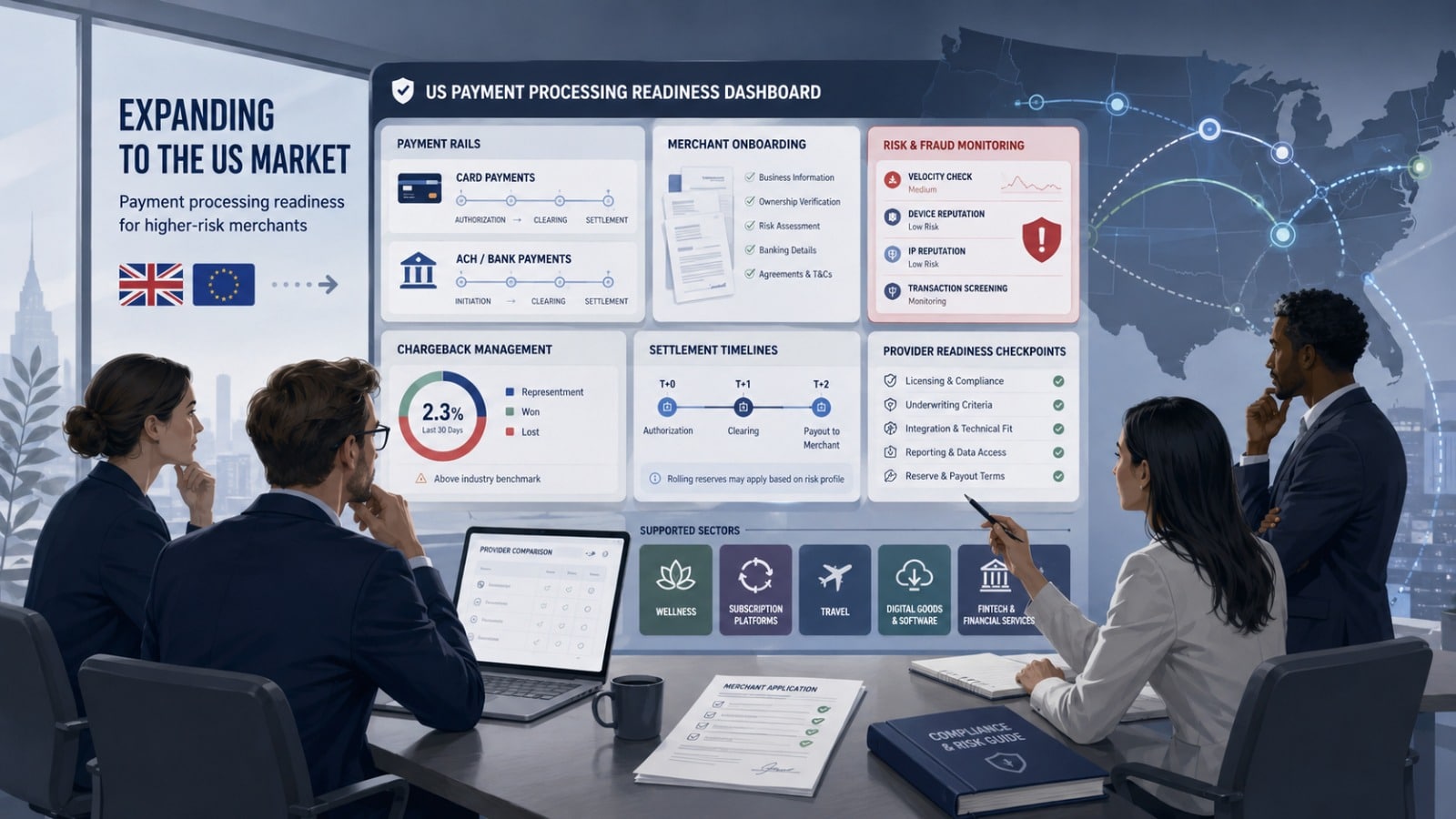
For UK and European online merchants, the United States can look like the most natural next growth market.
The language barrier is lower than in many regions. The consumer market is huge. Digital commerce is mature. Customers are familiar with subscriptions, online services, card payments, digital platforms, eCommerce brands and specialist products.
But payment processing in the US does not work exactly like payment processing in the UK or Europe.
A merchant that has been approved by a UK or European payment provider may still face new questions when entering the American market. A business that runs smoothly with domestic acquiring, European card acceptance or local payment methods may need a different structure for US customers, US settlement, ACH payments, chargeback management, fraud controls and provider onboarding.
This matters even more for higher-risk or higher-scrutiny sectors.
CBD, hemp, nutra, medical cannabis, dating, travel, digital goods, fintech, relationship-focused subscription platforms and other online business models may be legitimate and commercially strong. Yet they often need more preparation before approaching US payment partners.
US market entry should therefore begin with payment readiness, not only marketing.
The US opportunity is large, but payment expectations are different
The American eCommerce market is one of the largest in the world. The US Census Bureau estimated that US retail eCommerce sales reached approximately $326.7 billion in the first quarter of 2026, adjusted for seasonal variation.
That scale is attractive for UK and European merchants.
A British subscription platform may see the US as the next step because customers already understand recurring digital services. A European wellness brand may want access to a larger consumer market. A fintech company may want to serve US users or merchant clients. A digital goods business may want to sell content, access or online education to American customers.
The commercial logic is clear.
The payment logic is more complex.
US payment partners may review company structure, ownership, processing history, customer geography, product category, refund policies, chargeback levels, fraud controls, fulfilment process, website transparency and support arrangements. In higher-scrutiny sectors, they may also ask for licences, product documents, claims review, compliance policies or additional explanation of the business model.
The fact that a business has demand does not mean it is ready for US payment onboarding.
UK and European payment experience does not automatically transfer
Many UK and European merchants are familiar with card acceptance, Strong Customer Authentication, local payment methods, open banking and European acquiring relationships.
That experience is valuable, but it does not remove the need for US-specific payment planning.
The US market has different issuer behaviour, different chargeback patterns, different customer support expectations and different bank-payment rails. It also has a large ACH ecosystem, which many non-US merchants underestimate.
Nacha reported that the ACH Network processed 35.2 billion payments in 2025 with a value of $93 trillion. Same Day ACH reached 1.4 billion payments worth $3.9 trillion.
For merchants, ACH and pay-by-bank options may matter for recurring payments, B2B collections, account-based transactions, high-value purchases, marketplace settlement and invoice-based models. Cards will still be central for many consumer transactions, but they should not be the only payment rail considered.
A proper US payment plan should ask:
- Will customers mainly pay by card, bank account or both?
- Is ACH relevant for subscriptions, invoices or larger payments?
- Which payment methods fit the business model and customer type?
- How will refunds be handled?
- How will settlement timing affect cash flow?
- How will fraud be monitored across payment rails?
- Which providers actually support the merchant’s sector?
Higher-risk sectors need clearer preparation
Not every merchant faces the same level of payment review.
A standard low-risk retail business may have a simpler onboarding path. A merchant in a higher-scrutiny sector may need stronger documentation and a more careful provider match.
For example, CBD, hemp and nutra merchants may need stronger product documentation, claims review and refund policies before entering the US. Medical cannabis businesses may need even more careful review of licensing context, market coverage, product rules and payment-provider appetite. Dating and relationship-focused subscription platforms may need clearer recurring billing, cancellation flows, descriptors and customer-support procedures. Travel, booking, digital goods and fintech businesses may face different settlement, chargeback and provider-review questions.
The key point is not that these sectors cannot operate.
The point is that they should not approach US payment processing as if they were ordinary low-risk retail merchants.
A provider may ask:
- What exactly does the business sell?
- Where are customers located?
- Are products regulated or restricted?
- Are claims made on the website?
- How are refunds and cancellations handled?
- Are subscription terms clear before payment?
- What is the historical chargeback ratio?
- How is fraud reviewed?
- Are fulfilment timelines realistic?
- What documents support the merchant’s category?
A merchant that can answer these questions clearly is in a stronger position than one that treats payment onboarding as a formality.
Chargebacks carry more than financial cost
Chargebacks are often discussed as a direct cost. For US market entry, they are also a credibility issue.
If disputes rise after a merchant enters the US, payment partners may ask whether the problem comes from fraud, unclear billing, delivery delays, confusing descriptors, subscription issues, refund friction or customer-support gaps.
Visa’s 2025 Visa Acquirer Monitoring Program fact sheet explains that Visa monitors fraud, dispute and enumeration levels monthly and identifies acquirers or merchants that exceed programme thresholds.
For merchants, the practical message is simple: disputes are visible within the payment ecosystem.
A dating or membership platform with unclear recurring billing may create avoidable disputes. A wellness or nutra brand with unclear product expectations may create refund pressure. A travel merchant with complex cancellation terms may face customer confusion. A digital goods platform may receive disputes when customers cannot access content or do not recognise the descriptor.
Chargeback prevention should therefore begin before US launch.
Merchants should review:
- billing descriptors;
- refund and cancellation policies;
- subscription renewal notices;
- delivery and fulfilment timelines;
- customer-support availability for US time zones;
- dispute evidence collection;
- fraud-screening rules;
- support escalation before customers contact their bank.
Winning disputes is useful. Preventing avoidable disputes is better.
US customer support can become a payment issue
Many UK and European merchants underestimate support coverage when entering the US.
A UK company may have strong support during British business hours. But a US customer who cannot resolve a billing issue quickly may contact the card issuer instead. This is especially relevant for subscriptions, relationship-focused platforms, travel bookings, digital products and higher-value purchases.
Support quality affects payment stability.
Customers should be able to understand:
- who charged them;
- what they bought;
- when they will be billed again;
- how to cancel;
- how to request a refund;
- how to access the product or service;
- how long delivery or fulfilment should take.
For higher-risk merchants, this is not only a customer-experience issue. It is part of payment readiness.
A business that can resolve problems before they become disputes is easier for payment partners to understand and support.
ACH and bank payments require controls too
Some merchants see ACH and pay-by-bank as a way to reduce dependence on cards. That can be useful, but bank-based payments are not risk-free.
ACH and account-to-account flows can still involve unauthorised transactions, account takeover, refund abuse, social engineering, false-pretense payments and onboarding weaknesses.
Nacha’s 2026 risk-management updates make this point clear. Nacha announced that new fraud-monitoring rules affect all ODFIs and, in phases, certain non-consumer originators, third-party service providers and third-party senders. The rules are intended to support risk-based processes for identifying ACH entries initiated due to fraud.
For merchants, the lesson is practical. If ACH or pay-by-bank is part of the US strategy, the merchant should understand:
- how account ownership is verified;
- what fraud monitoring applies;
- how failed payments are handled;
- how refunds are processed;
- how returns are reported;
- how settlement is reconciled;
- what payment partner responsibilities apply.
ACH can be valuable for SaaS, memberships, B2B services, online education, logistics and other account-based models. But it should be designed as part of a controlled payment system, not bolted on after card issues appear.
Entity, EIN and bank account questions should follow the strategy
Some UK and European merchants assume they must immediately create a US company before entering the American market. Others assume they can sell to US customers without changing anything.
The better answer depends on the business model.
Some payment partners may ask about a US entity, EIN, US bank account, domestic settlement route, local support presence or US-facing terms. In other cases, a merchant may first need a readiness review to understand whether such steps are necessary.
A US entity does not solve weak documentation.
A US bank account does not fix poor chargeback controls.
Domestic settlement does not remove the need for clear refunds and support.
Payment structure should follow the operating model.
Before deciding on company setup, merchants should understand:
- target states or customer regions;
- product category and restrictions;
- expected processing volume;
- settlement currency;
- refund and cancellation exposure;
- customer-support coverage;
- licensing context where relevant;
- provider requirements for the sector.
For high-scrutiny sectors, legal, compliance and payment questions are often connected. WiseAlt is not a law firm, but payment readiness should be coordinated with appropriate legal and regulatory advice where the business model requires it.
Provider fit matters more than brand recognition
A familiar payment brand may not be the right provider for every US-facing merchant.
Some providers are strong for low-risk eCommerce. Others may support subscription businesses, B2B invoices, ACH, marketplaces, fintech flows, travel, wellness, high-risk verticals or international merchants more effectively.
For higher-risk merchants, provider fit matters because the wrong match can lead to delays, reserves, restrictions, onboarding rejection or sudden disruption.
A merchant should ask:
- Does the provider support this sector?
- Does it understand international merchants entering the US?
- Can it support the expected payment methods?
- Does it support ACH or bank payments where needed?
- What documentation is required?
- How are reserves handled?
- What chargeback levels trigger review?
- Is there a backup route if the main setup becomes unavailable?
Payment readiness is partly about reducing surprises.
How WiseAlt supports US payment readiness
For UK, European and international merchants, entering the US payment market can be attractive, but the preparation should happen before advertising spend increases.
WiseAlt supports US payment readiness for higher-risk merchants by helping businesses review payment structure, provider suitability, onboarding documentation, chargeback exposure, fraud controls, settlement needs, ACH or bank-payment options and backup routes before approaching payment partners.
This can be relevant for CBD, hemp, nutra, medical cannabis, dating, travel, digital goods, fintech, subscription and other higher-scrutiny online businesses preparing for US entry.
WiseAlt is not a PSP, acquiring bank, payment gateway, card processor, law firm, money transmitter or approval guarantor. Its role is to help merchants prepare their payment setup and coordinate discussions with relevant payment-solution partners where appropriate.
What merchants should prepare before US entry
A practical US payment-readiness file should include:
- company and ownership documents;
- product and service descriptions;
- target US customer profile;
- expected processing volume;
- current processing history;
- refund, return and cancellation policies;
- subscription terms where applicable;
- product documentation for CBD, hemp, nutra or medical cannabis-related activity;
- licensing context where relevant;
- billing descriptor details;
- fraud controls;
- chargeback history;
- customer-support processes;
- settlement requirements;
- ACH or bank-payment needs;
- backup payment options.
The file does not need to be complicated. It needs to be clear enough for payment partners to understand the merchant’s model.
Final operating principle
The US market can be a major opportunity for UK and European merchants, especially those with products or platforms that already have international demand.
But US payment processing is not simply a copy of the UK or European setup.
The merchant may need different documentation, different provider conversations, different chargeback controls, different settlement planning and different support coverage. Higher-risk and higher-scrutiny sectors need even more preparation.
The strongest merchants prepare before they enter. They understand how US customers pay, how payment partners review the sector, how refunds and disputes will be handled, and which payment routes can support growth.
For merchants entering the American market, payment readiness is not paperwork. It is part of building a scalable US business.