

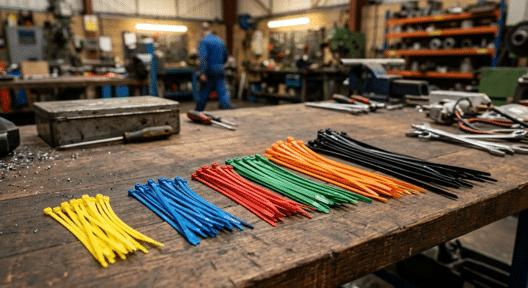
Cable ties look simple. Too simple to think about. But choose the wrong one and you will find out: when the sun turns it brittle, when the bundle is a few millimetres too wide for the strap, or when the tensile load pulls the pawl through the rack. Here is what the spec sheet actually means.
The Three Numbers That Matter
Every cable tie is defined by three numbers: length, width, and tensile strength. Length runs from 75 mm up to 1,200 mm in standard ranges. Width governs clamping force. A 2.5 mm wide tie will hold a handful of 1.5 mm² signal wires securely. A 7.6 mm heavy-duty tie is what you reach for when bundling 25 mm² battery cables.
Tensile strength follows from width and material. A standard 100 mm × 2.5 mm nylon 6.6 tie delivers roughly 80 N (about 8 kgf); a 360 mm × 4.8 mm tie gives about 220 N. These numbers are printed on the pack, but most people read them once and then grab whatever is nearest. If you routinely bundle loom runs or heavy cables, sort your ties by width before you start so you are not fishing through a mixed drawer for the right size
.
Some ranges also specify a maximum bundle diameter. That is not a vague suggestion. Exceed it and the strap cannot wrap fully around the bundle, meaning the ratchet mechanism sits at an angle and the pawl engagement is partial. A tie that is too short for the bundle will fail at a fraction of its rated load. Measure your bundle, then add 25 per cent to the tie length as a safety margin.
Nylon 6.6 versus Nylon 6.12 It Matters
The vast majority of cable ties sold in the UK are moulded from nylon 6.6 (polyamide 66). It has a melting point around 255 °C, good abrasion resistance, and reasonable chemical resistance to oils, greases, and petrol. That suits engine bays, workshops, and general electrical work fine.
Nylon 6.12 trades a little mechanical strength for dramatically better moisture resistance and UV stability. It absorbs roughly half the water that 6.6 does, meaning less dimensional change and less embrittlement outdoors. If the cable tie lives in direct sunlight on a trailer, a horsebox, agricultural machinery, or a roof rack go with 6.12 or a UV-stabilised grade.
The standard black tie offers some UV resistance because carbon black is a UV inhibitor; natural (white) ties have almost none. Coloured ties sit somewhere in between depending on the pigment load. A bright red or yellow tie may look good for colour-coding your wiring, but the pigment load can actually accelerate UV degradation compared to black. Reserve coloured ties for interior use inside a dashboard, fuse box, or control panel and use black UV-stabilised ties for anything exposed to daylight.
Judging Tensile Strength Without a Datasheet
You can feel it. Pick up a budget tie sold loose in a mixed bag and a branded one side by side. Flex the strap between your fingers. The cheap one will feel softer less glass fibre reinforcement, lower fill percentage. Fasten both around a test bundle and pull. The budget tie will click as the pawl skips under load. The branded one will seat firmly and hold.
The formal test is standardised: a tie is fastened around a mandrel and pulled until the pawl slips or the strap breaks. Minimum loop tensile strength is the rating you see on the pack. A tie rated at 100 N will hold about 10 kg of static load indefinitely. Dynamic loads vibration, thermal cycling derate that considerably. For engine-bay work, double the rating you think you need.
On the other hand, you do not need a 540 N heavy-duty tie to secure a handful of speaker wires behind a dashboard. Overspecifying adds unnecessary bulk and cost. The art is matching the tie to the job: small ties for signal wiring, medium ties for general looms, heavy-duty ties for battery cables and structural bundling.
Releasable, Reusable, and Push-Mount
Standard cable ties are one-shot: pull the ratchet past the pawl and it locks. You cut it off and replace it. That is fine for permanent installations and cost-effective in bulk.
Releasable ties, truckelectrics.com stock them too, use a pawl that disengages with a small screwdriver or tab so you can open the loop without destroying the tie. Useful during prototyping, wiring harness mock-ups, or any situation where you will add wires later. The trade-off is lower pull-out resistance. Do not use releasable ties in high-vibration locations.
Push-mount ties have an integrated expansion plug that snaps into a 6.5 mm or 7 mm hole in sheet metal. They eliminate the adhesive pad failure point entirely. For routing wiring inside a vehicle body or a control cabinet, push-mount is cleaner and more durable than stick-on bases. They also allow you to pre-position the mounting points before running the cable, which makes harness routing significantly faster.
There is also the ball-lock or “beaded” cable tie that uses a series of balls on the strap rather than a ratchet common in food production and medical settings where bacteria can hide in the ratchet teeth. For general automotive and workshop use, they are overkill, but they are worth knowing about if you work on catering vehicles or ambulance conversions.
Temperature and Chemical Limits
Nylon 6.6 cable ties have a continuous operating range of roughly −40 °C to +85 °C, with intermittent exposure to 105 °C. That covers almost everything in a car, van, or light truck except locations immediately adjacent to the exhaust manifold or turbocharger. For high-heat locations ovens, kilns, boiler rooms you need PTFE ties or stainless steel bands.
Chemically, nylon is vulnerable to strong acids, alkalis, and some brake fluids. If the tie will contact battery acid, coolant, or aggressive workshop solvents, check the manufacturer’s chemical resistance chart. Stainless steel ties are the answer where chemical resistance is non-negotiable, though they cost more and require special tensioning tools. For most workshop purposes securing cables, organising hoses, bundling wires standard nylon 6.6 is perfectly adequate.
Accessories That Extend What a Tie Can Do
The adhesive cable-tie mount is the most common accessory. Stick a pad to a clean surface, snap the tie through it, and you have a fixed routing point. The 3M VHB foam pads are reliable on painted metal, plastics, and glass. They fail only when the surface is not cleaned with isopropyl alcohol first.
Tie-mounting headers plastic strips with multiple slots let you run several ties in parallel for organised loom routing. Cable-tie tools tension and cut the tie flush in one pull, saving your hands when you are fastening fifty or more in a session. A good tool applies consistent tension so you stop guessing whether it is tight enough.
Screw-mount bases offer a more permanent alternative to adhesive pads. A small self-tapping screw through the base into sheet metal or wood will hold more weight and withstand higher temperatures than any adhesive pad. If you are securing a heavy loom in a commercial vehicle, screw-mount is the way to go.
How Not to Use a Cable Tie
Fasten it too tight and you crush the insulation, creating a short-circuit path or a stress fracture in the conductor. Snug enough that the bundle cannot slide inside the loop, but not so tight that the tie leaves an impression in the wire insulation. For sensitive cables coaxial, fibre, data use hook-and-loop straps, not ratchet ties, or use purpose-made cushioned cable ties.
Do not reuse ties. The pawl wears on first engagement. A tie that has been released and re-fastened holds at a fraction of its rated tensile strength. Do not twist ties to shorten them; the twist creates a stress concentration that fails under vibration. Just cut the excess flush.
And do not zip-tie an exhaust heat shield. That is not what they are for. The heat embrittles nylon within weeks. Use a worm-drive clamp, which is designed for high-temperature exhaust applications.
Buying in Bulk versus By the Pack
If you are a DIY mechanic wiring a single accessory into your van, a pack of 100 mixed-length ties is all you need. If you run a workshop, buy by the box. The per-unit cost drops to a few pence per tie, and you will go through them faster than you expect. A box of 500 standard ties in three or four sizes will last most small garages a couple of months.
Grease Monkey Direct stocks cable ties in packs of 100, full box quantities, coloured and specialist ranges, and accessories including mounts, fixing pads, and tensioning tools. Everything ships from UK stock with fast delivery across the country.
Shop the full range of cable ties at greasemonkeydirect.co.uk/collections/cable-ties – in all sizes, colours, and materials including bulk boxes and specialist grades.