
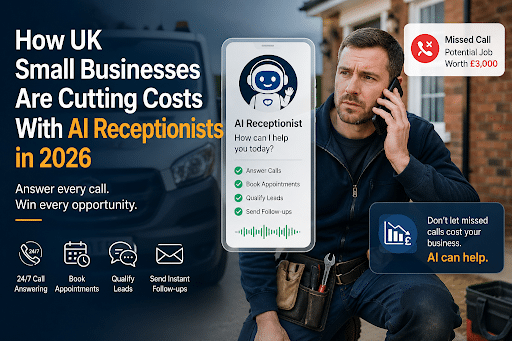
The Phone Call That Cost a Business £3,000
The plumber from Merseyside is halfway through completing a job when he receives a call on his cell phone. He cannot answer because he is working. By the time he returns the call, there is no voicemail. The client has moved on to another service provider.
Just like that, a £3,000 job is lost.
This is not a rare incident in the UK. Missed call scenarios happen all the time. Clients demand prompt response, and when their demands are ignored, they switch to other companies. Not many will place a second call, and fewer will send a voicemail message.
Until recently, the only solution to such problems would be hiring an assistant to answer client calls. But employing an assistant can be very expensive – especially when you factor in the annual salary range of £22,000 to £28,000.
Now, more businesses are turning to an AI receptionist for small businesses to handle calls without adding that financial burden — ensuring no opportunity is missed, even when they’re busy on the job.
What’s Actually Changed in 2026?
Staffing costs have made human receptionists unaffordable for small businesses
Operating a small company in 2026 is more costly than ever before. The increase in the national minimum wage requirement, rise in National Insurance contributions, and the continuous cost of the physical office have made it challenging to hire front desk personnel.
Many small-to-medium-sized enterprises in the UK are unable to afford a receptionist due to the high overheads associated with even a part-time position.
AI has moved from enterprise software to a small business tool
AI receptionist software is no longer limited to large enterprises. In 2026, it has become an affordable and practical solution for small businesses across the UK.
An AI receptionist can receive calls, schedule appointments, screen clients, and dispatch follow-up emails. They operate without any downtime and can multitask by managing several incoming calls simultaneously.
It is because of this reason that the automated receptionist in the UK market has evolved to be the most practical category of small businesses.
The Real Numbers — What UK Businesses Are Saving
Cost comparison
| Option | Annual Cost (UK) | Availability | Key Limitations |
| Part-time receptionist | £12,000–£15,000 | Limited hours | Missed calls outside working hours |
| Full-time receptionist | £22,000–£28,000 + NI | Standard hours | High cost, cannot handle multiple calls |
| AI receptionist | £50–£300/month (approx.) | 24/7 availability | Requires initial setup |
The hidden cost most owners don’t calculate
However, it’s much more than just the cost savings associated with reduced salaries. It’s an issue of lost opportunities.
Consider for example how valuable the average customer may be in the trade or service industry. Every missed phone call might be worth several hundred or even thousands of pounds in profit.
Just imagine the following scenario:
If just one valid job opportunity were lost per week, amounting to £300 each, you’re losing out on £15,000 every year.
In addition, a lot of callers will never leave a message; they simply hang up. Here’s where round-the-clock call answering can make a big difference to your bottom line.
Which UK Businesses Are Seeing the Biggest Impact
Tradespeople — plumbers, electricians, builders
Tradespeople spend most of their day on-site, making it difficult to answer incoming calls. . Phone calls are not answered, and leads are getting cold very quickly. In connection with fierce competition, the first responder becomes the winner.
With the help of the AI answering service UK solution, it is possible to ensure instant reaction even on-the-go. As a result, you avoid missing phone calls from potential clients.
Private clinics and therapy practices
The healthcare-oriented companies face the problem of booking a large number of appointments. Clients expect a fast response time; otherwise, they may simply leave.
An AI answering service will make sure that all of your patients receive prompt and professional assistance.
Small legal, financial, and professional services firms
Professional service providers need to make a strong first impression from the very first interaction. However, many small businesses cannot afford to hire dedicated reception staff.
That’s where AI answering services for small businesses like Agentzap.ai come in, helping ensure every call is handled professionally without the added cost.
Is It Actually Reliable Enough to Trust With Your Customers?
For most business owners, consistency is a major issue.
Today’s AI reception systems are programmed to speak in the same way, professionally respond to enquiries, and use standardised scripts. They aren’t moody, don’t get sick and aren’t overwhelmed.
And they can handle multiple calls simultaneously – something that human receptionists can’t do – to ensure all customers are fully attended to.
What This Means for UK Small Businesses Going Forward
How UK businesses manage calls is rapidly evolving. Where once a dedicated receptionist was essential, many businesses are now adopting more efficient, cost-effective solutions. In 2026, with rising operational costs across the UK, business owners are taking a smarter, more strategic approach to customer communication.
A virtual receptionist is no longer a luxury for small businesses—it’s becoming a necessity. Missed calls, delayed responses, and inconsistent customer handling can lead to lost revenue. With 24/7 AI-powered call answering, businesses can stay responsive even outside traditional working hours.
This shift is similar to the rise of e-commerce and digital payments. Early adopters of AI-driven tools are already seeing clear benefits, including fewer missed opportunities, improved customer experience, and significant cost savings. Meanwhile, traditional setups continue to struggle with rising staffing costs and limited availability.
As AI receptionist solutions become more common, they are setting new standards for speed, consistency, and reliability. For growth-focused businesses, improving customer communication while controlling costs is now a top priority.
The real question is: how many opportunities can a business afford to miss before making the switch?