

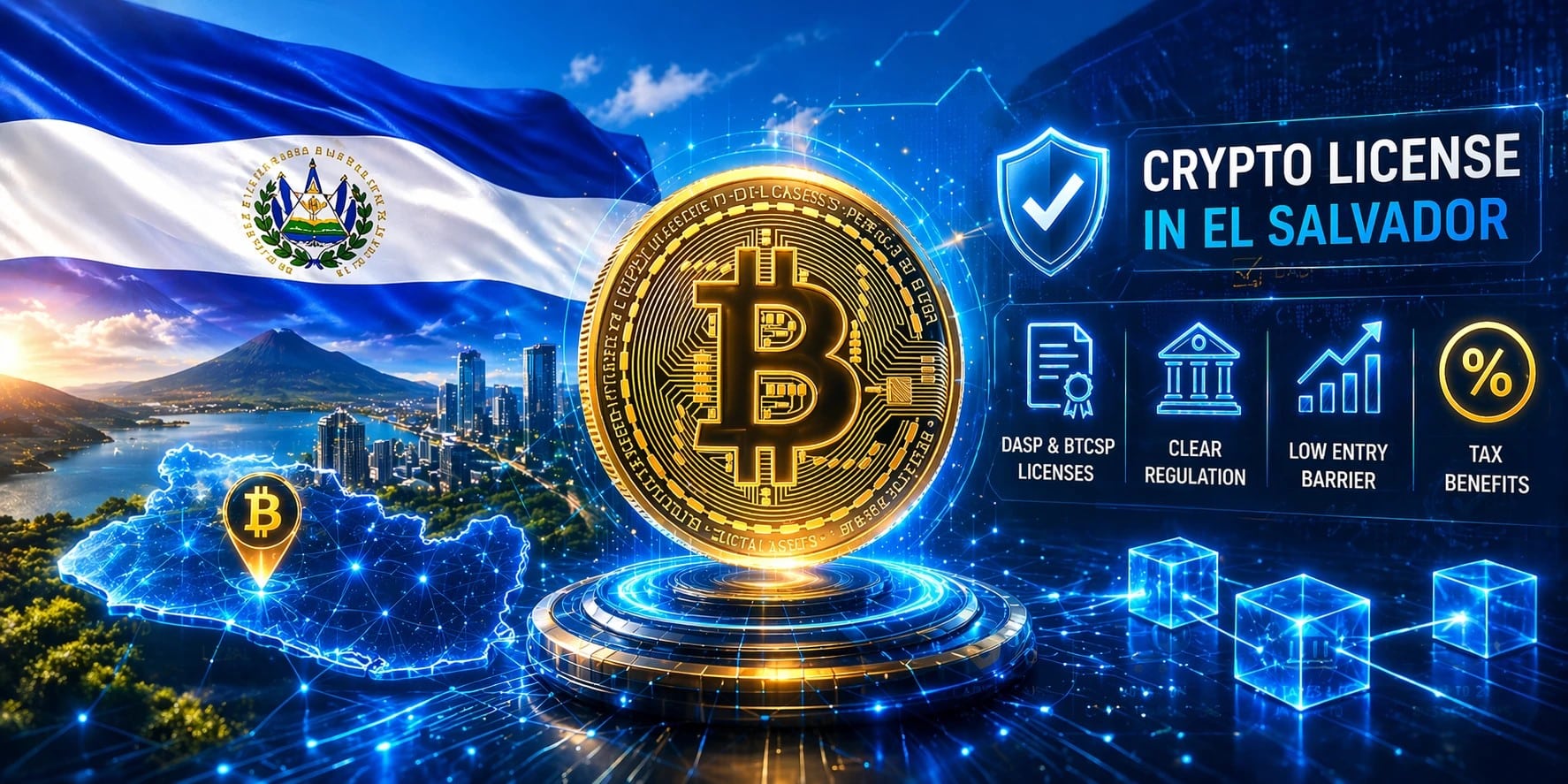
Not many countries can say they rewrote the rules of global finance. El Salvador did exactly that in June 2021, when its parliament passed the Bitcoin Law and made BTC official legal tender – the first time any nation had done so. That decision sent a clear signal to the international crypto industry: this is a jurisdiction that takes digital assets seriously.
Since then, El Salvador has gone further. The Digital Asset Issuance Law (LEAD), introduced in 2023, created a proper regulatory framework for the full range of crypto activities, not just Bitcoin. It established the National Commission of Digital Assets (CNAD) as the central licensing authority and introduced two distinct licence categories. For businesses looking to operate legally in the crypto space, El Salvador now offers one of the most clearly structured and accessible environments in Latin America.
Two Licence Types – One Clear System
The licensing framework in El Salvador is built around the nature of your business activity. If you work exclusively with Bitcoin – payment processing, BTC custody, remittance services – you need a BTCSP (Bitcoin Service Provider) licence, issued by the Central Reserve Bank (BCR). If your operations involve a broader range of digital assets – token issuance, multi-asset exchanges, NFTs, investment products – you apply for a DASP (Digital Asset Service Provider) licence through the CNAD.
Both licences sit within the same compliance framework. Licensed companies must implement AML and KYC procedures aligned with FATF standards, appoint a local Anti-Money Laundering Reporting Officer (MLRO), run real-time transaction monitoring, and report suspicious activity to the regulator within 24 hours. The requirements are demanding but clear, which is actually part of the appeal – you know exactly what is expected before you start.
What You Need to Apply
To get either licence, a company must first establish a local legal entity in El Salvador. This requires a minimum of two shareholders, valid identity documents for the legal representative, and notarised or consulate-legalised paperwork. A full AML/KYC compliance policy must be developed and ready at the point of application.
A local director is not a strict requirement, but in practice it makes things considerably smoother. Having someone on the ground who can communicate directly with regulators saves time and reduces the back-and-forth that tends to slow down applications. Once the submission is complete and the documentation is in order, the regulatory review typically takes up to 20 business days – a timeline that compares favourably with most European or Asian jurisdictions.
Minimum capital requirements start from around $2,000, which keeps the barrier to entry low. That said, applicants are expected to demonstrate genuine financial stability and a credible risk management framework – not just meet the minimum on paper.
The Tax Case for El Salvador
The regulatory structure alone would make El Salvador worth considering. The tax environment makes it considerably more interesting. Licensed DASP and BTCSP operators benefit from a package of exemptions that is genuinely unusual at the international level: no capital gains tax on Bitcoin and digital asset transactions, no VAT on cryptocurrency sales and exchanges, and no taxes on yields or income generated within the scope of regulated digital asset activities. Municipal and withholding taxes are also exempt for qualifying licence holders.
Where corporate tax does apply – at a standard rate of 30% for other sectors – licensed crypto companies can reduce their effective liability through deductions for operational costs such as legal fees, compliance, and audits. The government also permits fees and certain tax obligations to be settled directly in cryptocurrency, which reflects how genuinely embedded digital assets are in El Salvador’s financial system.
Prifinance: End-to-End Licensing Support
Understanding the requirements is one thing. Executing the process correctly, without delays and without compliance gaps, is another matter entirely. This is where experienced advisors make a practical difference.
Prifinance financial services is an international consulting company headquartered in Tallinn, Estonia, with over 28 years of experience in financial licensing, corporate structuring, and regulatory compliance across multiple jurisdictions. The company works with more than 6,000 clients worldwide and maintains established relationships with regulators, banks, and financial institutions across Europe, Latin America, and beyond.
For El Salvador specifically, Prifinance handles the full process: company formation, director appointment, AML/KYC policy preparation, corporate bank account opening, and end-to-end coordination with the CNAD or BCR. Their team has direct experience with both DASP and BTCSP applications and understands the practical aspects of working within Salvadoran regulatory requirements – not just the formal checklist.
If you are evaluating whether a crypto license El Salvador fits your business model, the Prifinance team can provide an honest, jurisdiction-specific assessment and a clear picture of what the process involves, how long it takes, and what it will cost.
Start the Conversation
El Salvador’s crypto licensing framework is structured, cost-efficient, and backed by some of the most favourable tax conditions available to digital asset businesses anywhere in the world. Whether you are launching a new project or looking to move an existing operation into a regulated jurisdiction, the opportunity is real and the process is accessible. Visit prifinance.com to request a consultation and take the first step toward operating your crypto business on solid legal ground.