


Workplace monitoring used to be simple. Clock in, clock out. Calls counted, emails logged. Staff knew what managers were tracking. Managers knew what the numbers meant. The rules were clear, even when nobody liked them.
That has changed over the years.
Today’s tools go far deeper. They pick up on how people write, catch problems the moment they surface, and expose workflow gaps that never make it into any report.
Some flag staff burnout weeks before the person themselves realises something is wrong. These systems are live inside companies across every industry right now.
The real question isn’t whether this is going on. It’s if anyone is being honest about it.
What Is AI-Powered Workplace Monitoring?
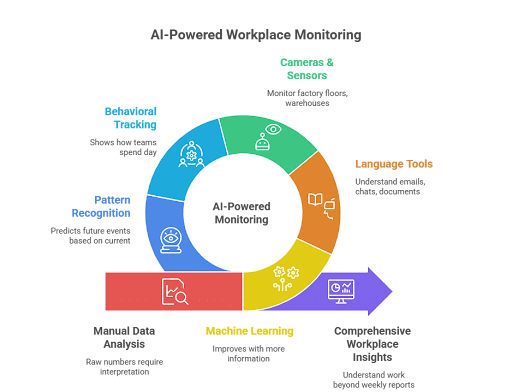
Older systems handed you raw numbers and walked away. Someone still had to sit down, dig through everything, and figure out what it meant. That step is gone now.
Modern AI tools read, sort, and flag things on their own around the clock. According to recent industry research, AI monitoring tools process up to 10 times more data points per employee than traditional systems ever could.
Self Generated
What sits behind them:
- Machine learning that gets better with the more information it gets
- Language tools that help you understand what emails, chats, and documents really mean
- Cameras and sensors monitor factory floors, warehouses, and hospital wards
- Behavioural tracking that shows how people and teams spend their day
- Pattern recognition that looks at what’s happening now to predict what’s coming next
Traditional Monitoring vs. AI Monitoring
| Feature | Traditional Monitoring | AI-Powered Monitoring |
| Data Collection | Manual or basic automation | Fully automated and continuous |
| Insights Generated | Limited, static reports | Deep, predictive, real-time insights |
| Accuracy | Moderate | High and self-correcting |
| Real-Time Analysis | Rarely available | Always available |
| Personalisation | None | Highly personalised |
| Decision Support | Minimal | Strong and data-backed |
| Burnout Detection | Not possible | Flags warning signs automatically |
| Compliance Tracking | Manual reviews required | Automated and continuous |
Key Ways AI Is Transforming Workplace Monitoring
1. Real-Time Productivity Analysis
The old monitoring method told you what happened last week. By the time a manager opened that report, the moment to act had already passed.
Unlike this, AI works right now in real time.
What managers can identify as it happens:
- Peak performance windows for individuals and teams
- Task completion rates and where work is stalling
- Workflow bottlenecks surfacing before they become bigger problems
- Output drops that need attention before they compound
Responding to a problem on the day it appears is a completely different management reality than reading about it a week later.
2. Behavioural Pattern Recognition
Tracking dozens of people simultaneously, each with different habits and stress responses, is beyond what human attention can reliably handle. AI does not exhibit that limitation.
What these systems catch that managers typically miss:
- A reliable employee whose response times have quietly doubled
- Someone with a clean record is suddenly missing deadlines repeatedly
- Teams showing disengagement before a single complaint has been raised
- Burnout patterns appear in data weeks before they surface visibly
When you catch these signals early, you can turn monitoring into something that helps people rather than just evaluating them.
3. Smart Time Tracking
Hours logged and hours utilised productively are two different things. Traditional tracking measured the first and called it the second.
What modern AI time tracking does differently:
- Categorises work types automatically without manual input
- Identifies when attention consistently drifts to low-value tasks
- Separates deep focused work from scattered task-switching
- Recommends scheduling based on when each person performs best
For employees willing to engage with this data honestly, it often reveals working patterns they had no idea existed.
4. Automated Compliance Monitoring
Regulated industries have always struggled with the same problem. Compliance demands constant vigilance, but human reviewers are limited and inconsistent. Things fall through the gaps. Fortunately, AI closes most of them.
What automated systems handle continuously:
- Data access tracking across every system at all times
- Immediate alerts when suspicious activities or violations occur
- Real-time policy checks without waiting for scheduled reviews
- Audit records that are always current without manual updates
This removes the blind spots that open up whenever compliance depends on people who are already stretched too thin.
5. Enhanced Remote Work Monitoring
Remote and hybrid work are the standards now rather than an exception. But managing distributed teams is genuinely hard, and AI addresses the most persistent challenges that come with it.
What AI brings to remote team management:
- Consistent productivity measurement regardless of location
- Collaboration quality assessed through actual outputs
- Performance evaluation that does not reward just office visibility
- Accountability that functions without constant check-ins
Remote workers have historically been evaluated partly on visibility, which disadvantaged them in ways unrelated to actual performance. Consistent data changes that dynamic.
Self Generated
Benefits of AI in Workplace Monitoring
The productivity gains are real and specific. When managers gain access to current information and tools to act on it quickly, teams perform better in practical ways. AI tools such as an ai image generator can also be used to visually represent workforce analytics, performance trends, and monitoring reports in a more understandable dashboard format for managers.
What organisations see with AI monitoring:
- Faster decisions grounded in evidence rather than instinct
- Burnout can be identified early enough to address before it becomes serious
- Operational costs are reduced as inefficiencies stop being invisible
- Fairer performance evaluation with less room for personal bias
- A shared accountability standard that employees and managers can trust
The well-being benefit deserves particular attention. Burnout is expensive, largely preventable, and historically difficult to catch early. A system that surfaces warning signs and puts them in front of someone who can act on them has genuine value for employees and organizations.
Future Trends and Impact on Employee Experience
Self Generated
The direction beyond 2026 is towards systems that understand people more deeply instead of just tracking them more closely. AI voice technology will read sentiments through communication patterns, and this will give managers a far richer understanding of team morale than text alone can provide.
Predictive workforce planning will anticipate hiring needs before shortfalls develop. Hyper-personalised environments will adjust dynamically to individual performance data. Wearable integration will connect physical health data directly to workplace systems.
When monitoring is built around genuine care for employees, the experience of work improves. Workloads become more balanced because imbalances are visible. Burnout gets caught before it becomes a crisis. Feedback becomes more specific and less shaped by personal relationships. Scheduling reflects when people perform well.
What changes between a positive and negative employee experience is not the technology. It is whether people feel the system was designed for them or used against them.
Challenges of AI Workplace Monitoring
Covering only the upside would be an incomplete picture. The challenges here are real.
What usually derails AI monitoring implementations:
- Privacy concerns where employees feel watched without understanding why, creating distrust that spreads fast
- Over-monitoring that suppresses creativity and autonomous work that produce real results
- Data security risks because behavioural data is sensitive and valuable
- Context misreading where AI flags a personal rough patch as disengagement, and someone acts on it wrongly
- Trust erosion when monitoring feels punitive, which produces the disengagement it was meant to prevent
These are organisational problems and hence, they require genuine commitment to address them.
Ethical Considerations in 2026
Many organisations claim to practice ethical AI monitoring. But only a handful practices it consistently. The principles are not complicated but require ongoing effort rather than a one-time policy decision.
What genuine ethical practice looks like:
- Transparency so employees know what is monitored and who sees it
- Consent communicated clearly before monitoring begins
- Fairness through regular audits to catch biased outcomes before they compound
- Purpose limitation means data is only collected for specific and defined reasons
Organisations that treat these as real commitments rather than legal formalities can build measurably stronger employee trust. That shows up directly in retention and performance.
Self Generated
Best Practices for Implementing AI Monitoring
During rollout, focus on:
- Selecting tools that fit your needs rather than deploying every available feature
- Communicating directly with employees about what is tracked and how it benefits them
- Building evaluation around meaningful outcomes rather than visible activities
- Reviewing the system regularly with a willingness to change what is not working
The communication step is where most implementations fail. Employees who understand the purpose of monitoring engage with it completely differently from those who simply feel watched.
Use Cases Across Industries
| Industry | Primary Use Case | Key Benefit |
| IT and Software | Development productivity tracking | Faster identification of bottlenecks |
| Customer Support | Response time and quality monitoring | Consistent service standards |
| Manufacturing | Safety compliance and efficiency | Fewer accidents, smoother production |
| Healthcare | Staff workflow monitoring | Lower error rates, better treatment outcomes |
| Finance | Compliance and security monitoring | Reduced audit risk |
Final Thoughts
AI has changed workplace monitoring for good, and companies are dealing with that whether they have thought it through or not.
Used responsibly, AI monitoring delivers:
- Stronger productivity built on real data rather than vague pressure
- Earlier support for staff before small problems turn serious
- Fairer decisions that cut down on personal bias at every level
But when used carelessly, it kills the trust that holds teams together faster than almost anything else leadership can do. The technology isn’t slowing down. Whether it’s worth using comes down to the intentions of the people behind it and how honestly they follow through.
Want to stay ahead of how AI is reshaping the modern workplace? Visit OTS News for the latest insights, analysis, and industry updates.